
TL;DR
- How to scale a covered call portfolio: hold position size at 2 to 5 percent and add names, not contracts on the same name, as capital grows.
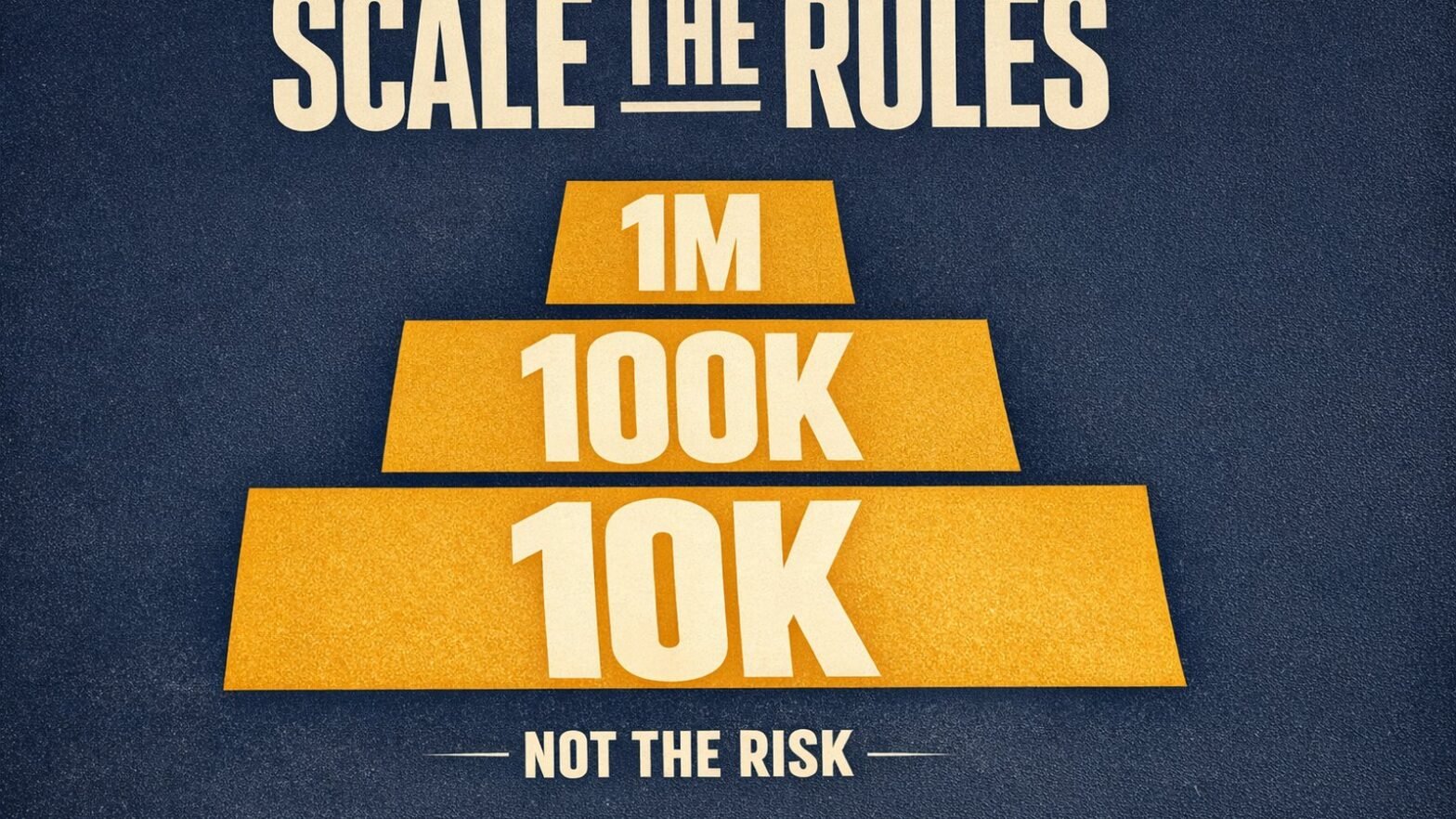
- At $10K you run one or two names. At $100K you run six to ten. At $1M you run twelve to twenty across sectors.
- The bottleneck is discipline, not capital. Same entry rules, same delta targets, same roll triggers at every level.
- Reinvest premium into new lots, not into doubling down on a single winner.
- Discipline is what turns covered calls for retirement income into a paycheck instead of a guess.

The myth of the bigger account
Most investors think a million dollar covered call account is somehow a different sport than a ten thousand dollar one. It is not. The same delta targets, the same expiration windows, the same roll triggers. What changes is the number of lots, the dollar size of each premium check, and the discipline required to keep doing the same boring thing twenty times a month instead of two.
I teach covered calls for retirement income across every account size in the Elite Course and the Mastermind. The biggest predictor of who hits a seven figure income book is not market timing. It is the willingness to run the same playbook at every stage. How to scale a covered call portfolio is mostly a story about not changing your mind.
The problem with growing the wrong way
Investors who blow up scaling efforts make the same three mistakes. They double up on a favorite stock and turn a 5 percent position into a 25 percent position. They chase higher-IV names outside their quality filter because the premium looks juicy. They skip rolls because the calendar got crowded. Each of those moves substitutes effort for discipline, and effort is the wrong currency.
The hard truth is that at $1M, a single bad position can cost more than a year of net income on a $10K account. A 25 percent position with a 30 percent drawdown is 75 grand on a $1M book. That is the kind of hole that ends a retirement income plan, even though every individual trade looked harmless when it was opened.
Strategy: a three-stage scaling roadmap
Stage one: $10K to $50K — focus and finish
At this size you have one or two names. Pick the highest quality, most liquid stock in your watchlist, in a price range that lets you actually buy 100 shares. Sell one covered call per cycle. Track every fill in a simple spreadsheet. Goal is not maximum premium. Goal is to complete fifty cycles without breaking your own rules.
Reinvest every dollar of premium plus any dividend back into the same brokerage account. Do not pay yourself yet. The point of stage one is building the muscle memory.
Stage two: $50K to $250K — diversify in waves
Now you can run three to six positions. Add names by sector. If you already own a technology dividend payer, the next add is consumer staples or industrials, not a second tech name. Each new lot should be sized so it lands between 2 and 5 percent of the total.
Position sizing is the single most important variable here. A 2 percent allocation forces diversification. A 5 percent cap protects against ego trades. Anything over 5 percent at this stage signals you are picking stocks instead of running an income system.
Stage three: $250K to $1M and beyond — scale the boring
At seven figures you should hold twelve to twenty names, balanced across at least five sectors, with a 5 percent cash reserve for adjustments. The premium income at this level becomes meaningful enough to live on, and that is when the temptation to “optimize” gets loudest. Resist it.
Covered calls for retirement income at this size are about repetition, not innovation. The MasterCourse Fortress strategy, the Balance Point setup, and the Rocket variation all still apply. The only thing different is the number of contracts and the size of each weekly premium check.
Numerical example: same rules, three account sizes
Assume an average monthly premium yield of 1.5 percent of capital deployed in covered calls. This is achievable on quality names with sensible delta selection.
| Account size | Names held | Avg position | Monthly premium | Annualized |
|---|---|---|---|---|
| $10,000 | 1 to 2 | $5,000 | $150 | $1,800 |
| $50,000 | 3 to 5 | $10,000 | $750 | $9,000 |
| $100,000 | 6 to 10 | $10,000 | $1,500 | $18,000 |
| $250,000 | 10 to 14 | $17,500 | $3,750 | $45,000 |
| $500,000 | 12 to 18 | $28,000 | $7,500 | $90,000 |
| $1,000,000 | 15 to 20 | $50,000 | $15,000 | $180,000 |
Three things to notice. The yield rate stays constant. The position sizes grow but the percentage stays roughly the same. The number of names grows faster than the position size, which is what gives the portfolio its safety. That is the entire model.
Risk management at every stage
The same risk rules apply at every dollar level. The difference is how disciplined you have to be to follow them.
- Cap each name at 5 percent. If a winner runs and pushes a position over the cap, take profit on a chunk and redeploy into a new name. This is the most violated rule on the way to a seven figure book.
- Hold a 5 to 10 percent cash reserve. Reserves let you roll tested positions, defend a basis, and pick up oversold quality names without forced selling.
- Use the same delta band at every size. Twenty to thirty delta on the short call, twenty to twenty-five delta on any cash secured put. Strategy does not change because the account grew.
- Stage three needs a calendar. Twenty positions across thirty to forty-five day cycles means rolls land daily. Use a recurring weekly review block instead of trying to manage on the fly.
The discipline question is louder at scale because the temptations are louder. A million dollar portfolio earning $15,000 a month feels like it should be earning more. It should not. Quality income at low variance is the entire point of covered calls for retirement.
FAQ
How many positions should I hold at each account size?
One to two names at $10K. Three to six at $50K to $100K. Ten to fourteen at $250K. Twelve to twenty at $500K to $1M. Anything tighter than that concentrates risk. Anything broader becomes hard to roll on time.
Do I reinvest premium into the same stock or buy new names?
Buy new names until your target diversification is hit. Reinvesting into an existing winner is how concentrated portfolios get built without anyone noticing. Spread the premium across the next sector you need exposure to.
Does my strategy change as I grow?
No. Delta, expiration, roll trigger, and exit rules stay identical. Position count and contract size scale. That is the whole secret to how to scale a covered call portfolio without losing discipline.
What is the most common mistake at the $250K to $500K stage?
Letting one position grow past the 5 percent cap because it is “the one that works.” Every covered call book I have seen blow up at that size had a single position too big. Trim ruthlessly. Redeploy into the next sector.
Conclusion: scale the rules, not the risk
How to scale a covered call portfolio is mostly about resisting the urge to change the playbook as the account grows. Hold position size at 2 to 5 percent. Add names. Reinvest premium across the book. Run the same delta band and the same roll triggers at every level. Boring scales. Clever does not.
If you want the full income system, including the exact delta tables, sector targets, and roll mechanics I use across every account size, the free MasterCourse is at cashflowmachine.net/options-mentorship. It walks through Fortress, Balance Point, and Rocket, and shows how each one looks at $10K, $100K, and $1M.
For more on building the income engine itself, the covered call hub lives at cashflowmachine.io/covered-calls.
Related: Read more about How to Build a Covered Call Portfolio From Scratch (Step-by-Step).
Related: Read more about Covered Call Income Reinvestment: How to Compound Premium Into a Larger Account.
For weekly setups, trade walkthroughs, and portfolio reviews, the @coveredcalls YouTube channel covers covered calls for retirement income in plain English.
Educational disclaimer: This content is for educational purposes only and does not constitute financial, investment, tax, or legal advice. Options trading involves significant risk and is not suitable for every investor. Always consult a licensed financial advisor and read the standardized options disclosure document before placing any options trade.
Put this into practice
Build a trading plan for your own stocks and get feedback from an AI coach trained on the Cash Flow Machine method.
Try CashFlowIQ free