
TL;DR
- Covered call income reinvestment turns monthly premium into more shares, which produce more premium next month, creating a true compounding flywheel.
- A $200,000 account earning 1.5 percent in monthly premium can compound to roughly $278,000 in three years if every dollar is reinvested.
- The two main ways to reinvest: buy more shares of the same name or rotate premium into the next high-quality underlying on your watchlist.
- Always keep a small cash buffer for assignments and corrections so the flywheel does not stall when you need it most.
- This is the engine that turns covered calls for retirement income from a side hustle into a serious wealth builder.
The Quietest Wealth Engine on Wall Street
Most people understand compounding when it comes to dividends. Reinvest the cash, buy more shares, watch the pile grow. Almost no one talks about doing the same thing with covered call premium. That is a shame, because the math is even better. Option premiums are typically two to three times the size of dividend yields on the same stock, and when you redeploy that cash back into shares, the snowball gets going much faster.
I have run my own Cash Flow Machine accounts on a strict covered call income reinvestment rule for decades. The premium that hits my account in week one becomes new shares by week two. Those shares generate more premium in the next cycle. The flywheel just keeps turning. This is one of the cleanest paths to scaling covered calls for retirement income from a side benefit into a serious wealth engine.
The Problem: Letting Premium Sit Idle
The most common mistake I see in new students is letting their cash balance balloon. They collect $1,200 of premium in a month, see the number, smile, and leave it sitting in the sweep account earning four or five percent. That feels safe. It also kills the compounding.
If that $1,200 is reinvested at the same monthly yield the rest of the portfolio earns, it becomes part of next month’s premium engine. Let it sit, and you are essentially earning bond rates on a portion of your account that should be earning equity option rates. Over a few years the gap becomes enormous.
The other mistake is unstructured spending. Premium hits, the temptation to upgrade something at home is real, and the cash drifts off. There is nothing wrong with using premium for lifestyle if that is the plan. But it needs to be a deliberate choice, not a default leak.
The Strategy: Three Ways to Redeploy Premium
Method One: Buy More of the Same
The simplest version of covered call income reinvestment is to use the premium to buy more shares of the same underlying. If you sold a call on AAPL and collected $400, you redeploy that $400 into more AAPL shares as soon as it settles. Over time, your share count creeps higher, and each new round lot lets you sell another call. This is the closest analogue to a DRIP, just with option premium instead of dividends.
Method Two: Rotate to the Best Setup
The smarter version is to look at your watchlist and put the new cash into whichever quality name has the best risk-adjusted setup that week. Maybe the stock you sold the call on already had a big run and is no longer your best add. Maybe a different position in the portfolio is closer to its support level or has higher implied volatility on the next expiration. You pour the premium into the place it works hardest.
Method Three: Build a Cash Reserve Layer
Not every dollar has to be reinvested immediately. I keep roughly 5 to 10 percent of the portfolio in cash specifically to handle assignments, corrections, and opportunities. When premium comes in, a portion can top up that reserve if it has been drawn down. That cash is dry powder for the next dip or the next great underlying that comes onto the radar.
A Real Numbers Example: $200,000 Account, Three Years
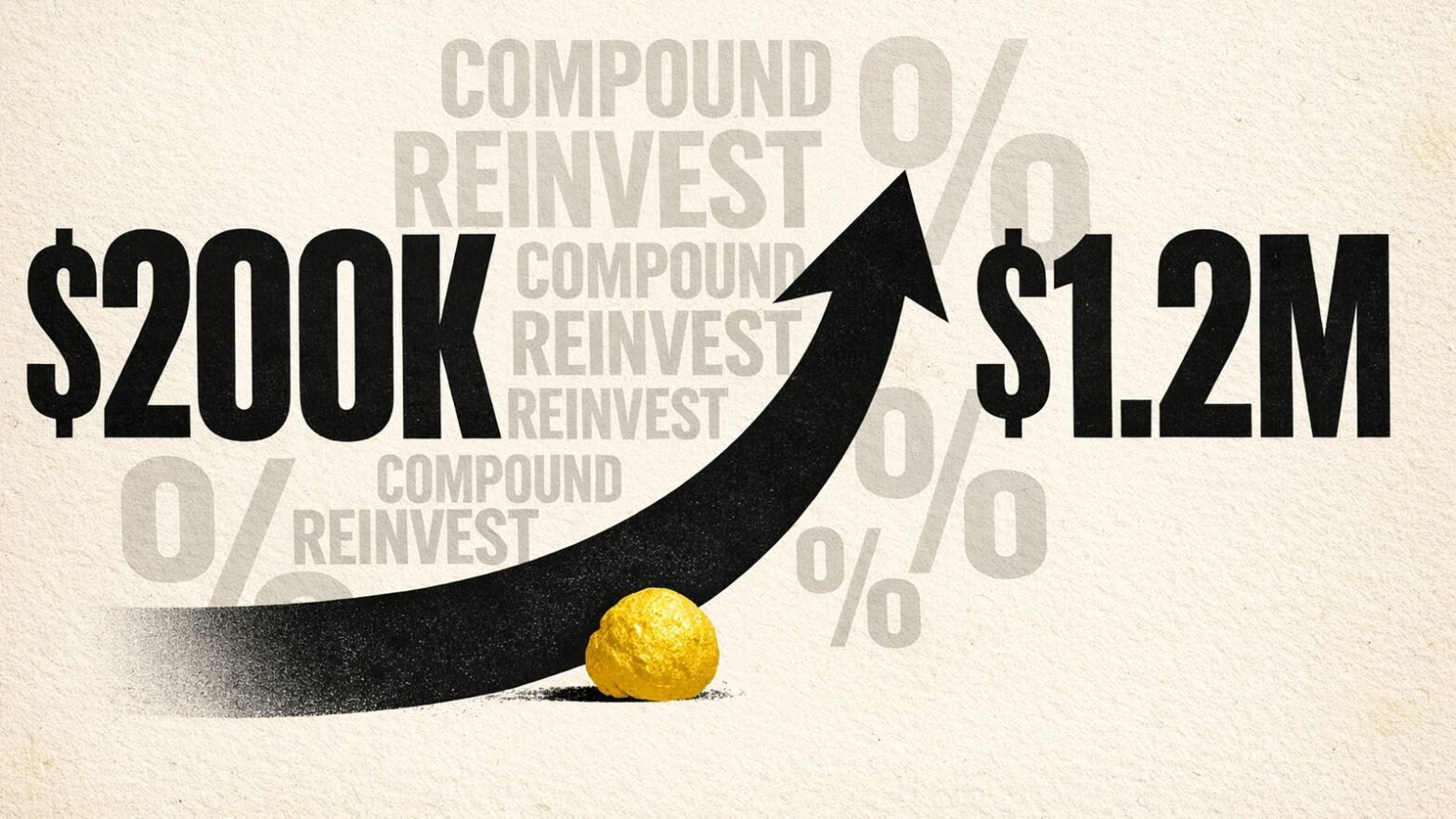
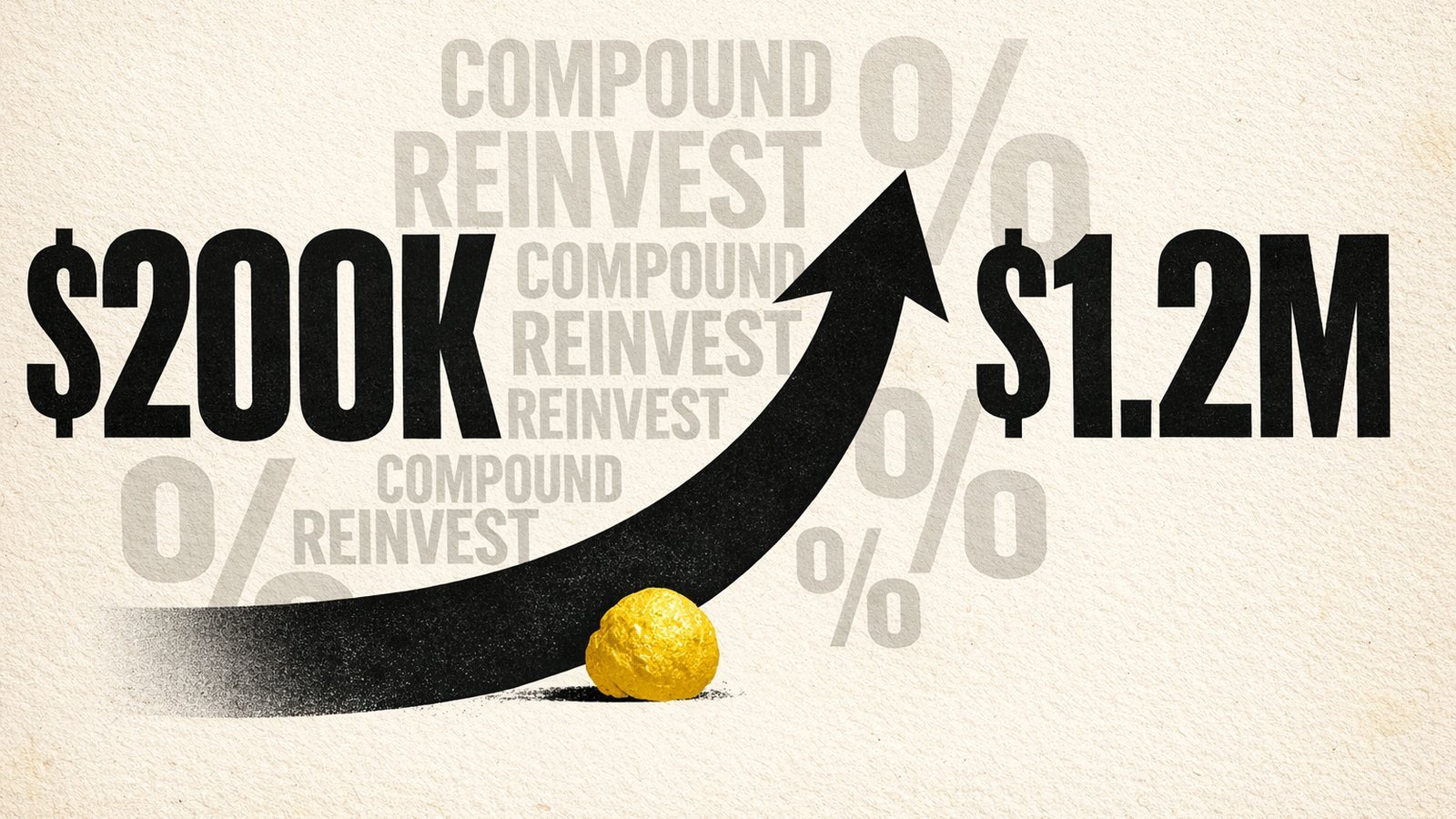
Let me show you what disciplined covered call income reinvestment actually does over time. Assume a $200,000 account earning a steady 1.5 percent net monthly premium after costs, with every dollar reinvested at that same rate.
| End of | Account Value | Monthly Premium |
|---|---|---|
| Year 1 | about $239,000 | about $3,580 |
| Year 2 | about $286,000 | about $4,290 |
| Year 3 | about $342,000 | about $5,130 |
| Year 5 | about $491,000 | about $7,370 |
| Year 10 | about $1,205,000 | about $18,080 |
Look at the year ten line. Without adding a single new dollar of outside capital, the account has crossed a million and the monthly premium has grown to over $18,000. That is the quiet magic of compounding. The first year barely feels like anything is happening. By year five the numbers get serious. By year ten the income alone covers most retirement spending plans.
Now compare that to the same account that pulled the premium out and spent it each month. After ten years the account is still around $200,000 (give or take share appreciation) and the monthly income is still about $3,000 in real terms. Both outcomes are fine, but they are very different lives.
This is exactly the framework I teach inside the Mastermind. The math is not the hard part. The discipline of doing it every single month is the hard part.
Risk Management: Protect the Flywheel
A reinvestment program only works if the underlying engine keeps running. Here is how I protect it.
Cap any single position. No matter how much I love a name, I do not let it grow past 10 to 12 percent of the account through reinvestment. If reinvested premium would push a position over the cap, the extra cash goes to a different name on the watchlist.
Keep the cash buffer real. A 5 to 10 percent cash reserve is not idle. It is what lets you handle assignments and opportunistic buying without forced selling. When the buffer drops below target, the next month’s premium tops it up before any reinvestment.
Diversify across sectors. Reinvestment makes correlation creep a real risk. If three of your top positions are mega-cap tech, a sector drawdown hits all three at once. Spread the engine across tech, financials, healthcare, energy, and a defensive name or two.
Avoid reinvesting into weakness. If a stock you own has broken its fundamentals, do not let the reinvestment rule keep pouring money into it. Premium is fuel. Pour it into healthy underlyings, not deteriorating ones.
Review the engine quarterly. Once every three months I look at the actual realized monthly yield, the share count growth, and the cash buffer. If the numbers are drifting from the plan, I adjust strike selection or rotation before small problems become big ones.
Frequently Asked Questions
Should I reinvest covered call premium or take it as income?
It depends on your stage of life. If you are still building the account, reinvest. Compounding the premium back into shares is the fastest way to grow your monthly cash flow without adding new capital. If you are already drawing income to live on, take what you need to spend and reinvest the rest. Many of my Elite Course retirees split the premium roughly 70 percent income, 30 percent reinvested.
What is the difference between a DRIP and covered call income reinvestment?
A DRIP automatically reinvests dividend cash into more shares of the same stock. Covered call income reinvestment uses option premium instead of dividends and is usually manual. You have more control over which stock the new cash goes into, which lets you redirect premium to whatever underlying offers the best risk-adjusted setup that week.
How fast can a covered call account compound?
At a conservative 1.5 percent monthly net premium, an account roughly doubles every four years if every premium dollar is reinvested. Faster monthly yields compound faster, but they also carry more assignment and drawdown risk. Most disciplined Cash Flow Machine students target a sustainable 15 to 24 percent annualized compound rate.
Should I reinvest premium inside an IRA?
Absolutely. Compounding covered calls for retirement income inside a tax-advantaged account is one of the most powerful things you can do. Every reinvested dollar grows tax-deferred in a traditional IRA or tax-free in a Roth, so the math works harder for you than in a taxable account.
The Bottom Line: Reinvest the Engine, Not Just the Output
Every covered call you sell creates a small pile of cash. What you do with that cash is what determines whether you end up with a stagnant account that pays you the same dollar amount forever or a growing engine that hands you a bigger paycheck every year. Covered call income reinvestment is the bridge between those two outcomes. It is not flashy, it is not glamorous, and it does not show up on the cover of any magazine. It just quietly multiplies your share count and your premium-generating capacity month after month after month.
If you want the exact watchlist construction, position-sizing rules, and reinvestment cadence I use, the Free MasterCourse covers them. You can grab it at cashflowmachine.net/options-mentorship. My Elite Course and the Mastermind program then walk you through building a real reinvestment ledger and reviewing it together.
For the broader Cash Flow Machine library, including foundational covered call mechanics and the Fortress, Balance Point, and Rocket frameworks, visit cashflowmachine.io/covered-calls.
Related: Read more about Covered Call Strategy for Early Retirement: The Income Plan That Lets You Quit at 50.
Related: Read more about How Covered Call Income Protects Your Portfolio During Inflation.
I walk through real reinvestment math each week on the Covered Calls YouTube channel. Subscribe at youtube.com/@coveredcalls to see how the flywheel runs in live accounts.
Educational disclaimer: This content is for educational purposes only and does not constitute financial, investment, tax, or legal advice. Options trading involves significant risk and is not suitable for every investor. Always consult a licensed financial advisor and read the standardized options disclosure document before placing any options trade.