
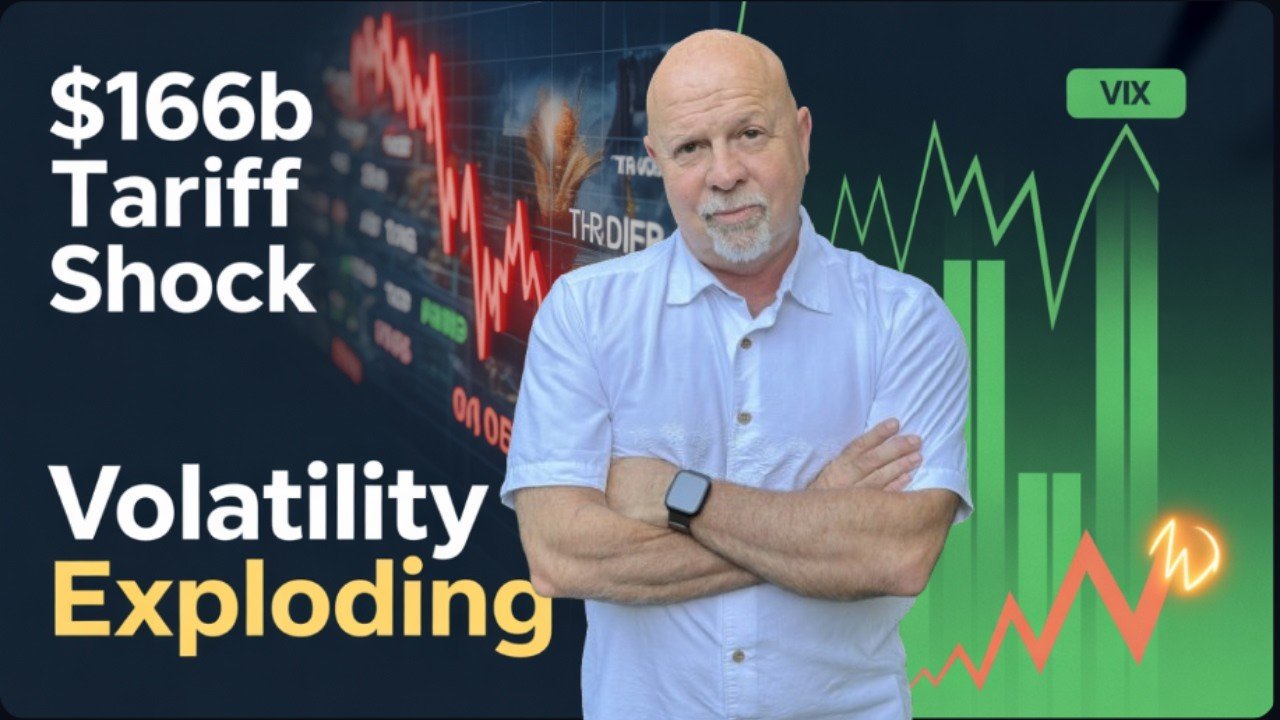
Tariff Refund Chaos and Market Volatility: A Clear Way to Think About Your Portfolio
$166 billion. That’s about how much U.S. Customs and Border Protection (CBP) collected from a set of tariffs that courts have now said should be refunded. (AP News)
Here’s the wild part: CBP told the court they can’t refund that money quickly because their systems can’t handle it at scale. They’re talking about building a new process that could take roughly 45 days—which lands around late April. (AP News)
If that sounds like organized chaos at the highest levels of economic policy… you’re not imagining it.
And if you’re sitting on a serious portfolio wondering what this means for your Investing plan, there is a clear-headed way to think about it.
Image suggestion: A simple timeline graphic: “Tariffs imposed → Supreme Court ruling → Trade court refund order → CBP says ‘system can’t do it yet’,” plus a small chart of the VIX rising during uncertainty.
The 90-Second Version of What Happened
The big headline is about tariffs imposed under the International Emergency Economic Powers Act (IEEPA) and the legal fight over whether the President had that authority. (SCOTUSblog)
- In February 2026, the U.S. Supreme Court struck down the sweeping IEEPA-based tariffs, saying they exceeded presidential authority under that law. (SCOTUSblog)
- After that, the U.S. Court of International Trade ruled that importers are entitled to refunds (with interest). (AP News)
- CBP says the scale is massive: 330,000+ importers and 53 million+ individual entries, and the current system would take millions of labor hours to process manually. (AP News)
So yes—refunds may come, but not instantly. CBP says they need a streamlined system and court approval before it can roll out. (AP News)
Why This Matters to Markets (More Than the Politics)
This isn’t just “news.” It’s a signal that the rules of the economic game can change quickly—and that uncertainty can stick around.
You can see that stress show up in a few places:
- Consumer sentiment has been weak. The University of Michigan index was 56.4 in January 2026 and 56.6 in February 2026, which is low by historical standards. (fred.stlouisfed.org)
- Volatility has been jumpy. The VIX has swung sharply in early March amid geopolitical and policy uncertainty, moving into the 20s and even higher during spikes. (The Times)
Here’s the key idea:
Uncertainty doesn’t only create risk. It also creates opportunity—if you have a system.
The Mistake Most Investors Make in Moments Like This
Most investors hear “uncertainty” and do one of two things:
- Freeze and wait
- Panic and sell at the wrong time
That’s not a plan. That’s emotion.
If you’re building Passive Income and Retirement Income, you usually need something better than “hope the market calms down.”
This is where Covered Calls can come in.
Why Covered Calls Can Pay More When Volatility Rises
Options pricing is heavily influenced by implied volatility. When volatility rises, option premiums often rise with it. That’s why “fear” can literally show up as higher premiums for option sellers.
So when the market is on edge—tariffs, courts, refund bottlenecks, shifting policy—premiums can be elevated because traders are paying up for protection and leverage.
That’s the mental flip:
Instead of only fearing volatility, a systematic investor can monetize it.
Understanding Covered Calls (Quick and Simple)
A covered call is straightforward:
- You own 100 shares of a stock (per contract).
- You sell a call option against those shares.
- You collect premium up front (cash in your account).
If the stock stays below your strike price, you often keep the premium and keep your shares.
If it rises above your strike, your shares may get called away at the strike price (you still keep the premium).
This is an income strategy, not a “hit-a-home-run” strategy.
Used correctly, it can support Retirement Income by creating a repeatable cash-flow layer on top of stock ownership.
The Real Edge: What You Do When the Market Moves Against You
A lot of people stop at “sell a call, collect premium.”
That’s not the edge.
The edge is having a defensive playbook for when markets whip around—because in a world where policy can reverse quickly, you need rules for adjustments.
That includes knowing:
- when to roll
- when to reduce size
- when to step aside
- when to accept assignment
- when a stock no longer fits your plan
A surface-level approach can work in calm markets. In unstable markets, it can hurt you.
A Practical Covered Call Playbook for Uncertain Markets
Here’s a simple framework many income traders use:
If the stock rises fast
- Expect assignment risk to increase
- Consider rolling up and/or out only if it fits your plan
- Don’t “chase upside” with an income strategy
If the stock chops sideways
- This is often the sweet spot for covered call income
- Let time decay work
- Stay consistent and repeat the cycle
If the stock drops hard
- Premium is a cushion, not armor
- Reduce risk with position sizing and pre-planned exits
- Consider defensive adjustments (not emotional ones)
10 Practical Tips to Trade Covered Calls Like a System (Not a Guess)
- Use liquid stocks with tight bid/ask spreads.
- Start small until your adjustment process is automatic.
- Choose strikes you’d be happy selling at (assignment is not a tragedy).
- Don’t sell calls right before major events unless you have a rule for it.
- Build a habit of checking implied volatility before selling calls.
- Define your “pain point” in advance: what stock drop triggers action?
- Size positions so one trade can’t wreck your month.
- Have a rule for rolling (when, why, and how far).
- Track monthly premium like a business tracks revenue.
- When headlines get louder, lean harder on your rules, not your feelings.
FAQs
1) Does tariff uncertainty automatically mean the market will crash?
No. It means the market may re-price risk quickly. The bigger issue is uncertainty and sudden shifts, which can increase volatility. (SCOTUSblog)
2) How do covered calls help with Passive Income?
Covered calls collect premium up front. If you run them consistently, the premiums can become a repeatable cash-flow stream—like “rent” on stocks.
3) What’s the biggest risk with covered calls?
A sharp drop in the stock. Premium helps a little, but you still own the downside. That’s why position sizing and a defensive plan matter most.
4) Are refunds on the tariffs happening soon?
CBP has said it needs a new streamlined process and estimated about 45 days to get it ready, subject to court approval. (AP News)
Call to Action
If you want your portfolio to produce more dependable Passive Income and Retirement Income, start with one simple step:
Pick one high-quality stock you already own, sell one conservative covered call, and track:
- premium collected
- what you felt during the trade
- what your rules told you to do
Then repeat—system beats emotion.
If you want to go deeper, Mark also mentioned the Wealth Accelerator Live Strategy Room near Phoenix, Arizona, April 17–19, 2026 (limited seats, hotel rooms moving fast).
Educational disclaimer: This content is for education and information only. It is not financial advice.
Conclusion
A $166 billion refund backlog isn’t just a paperwork story. It’s a message: policy risk is real, and uncertainty can linger. (AP News)
For most investors, that creates stress and hesitation.
For systematic investors, it can create a productive environment—because elevated volatility often means elevated option premiums.
You don’t need perfect predictions. You need a process that works across conditions.